
Commercial Solar Panels For Your Business
Go solar & see your energy bill savings pay for the cost of your system typically within 3 to 6 years
Get A Free Solar Assessment
It takes only 3 minutes or less...

Full Turnkey Solar Projects
3-6 Years Pay Back
40+ Years Industry Experience
Or call us to speak directly with our team about your commercial solar enquiry
Commercial Solar Panels
For Your Business
Go solar & see your energy bill savings pay for the cost of your system typically within 3 to 6 years
Get A Free Solar Assessment
It takes only 3 minutes or less...
Full Turnkey Solar Projects
3-6 Years Pay Back
40+ Years Industry Experience

GOV.UK
Helping Achieve
Net Zero Emissions by 2050
How It Works
From assessment to installation — we manage the entire process

1. Speak To An Expert
Get in touch with the Armex team through our website or by phone. One of our commercial solar specialists will discuss your building, energy usage and business goals.

2. Site Assessment
Every project starts with an assessment of your site. We review your energy usage, operational profile, and any roof or land constraints.

3. Bespoke Proposal
At Armex, we don’t use templated proposals for commercial solar PV systems. Your system is designed around your building and how your business uses energy.

4. Cost & Savings Guidance
You’ll receive guidance on capital costs, payback periods, and long-term savings projections. We also assess the EPC impact before you commit.

5. Compliance & Installation
Our team handles EPC documentation, DNO applications, and any building regulations. Installation is scheduled around your operations to minimise disruption.

6. Monitoring & Maintenance
After handover, we provide remote monitoring with fault alerts. Long-term maintenance includes servicing and thermal imaging inspections.

7. Start Saving
Once installed, your system begins generating electricity for your business. This helps reduce energy bills and delivers long-term savings.
Does this apply to your business?

Keen to reduce your business electricity bills

Want to reduce reliance on the energy grid

Want to reduce your carbon footprint

Keen to reduce your business electricity bills
We Help Businesses Save Time & Cut Energy Costs
We deliver end-to-end solar solutions in-house, starting with a free assessment and tailored system proposal.
Using real consumption data, we model your energy usage to provide accurate savings forecasts, optimal system design, and a clear ROI breakdown.
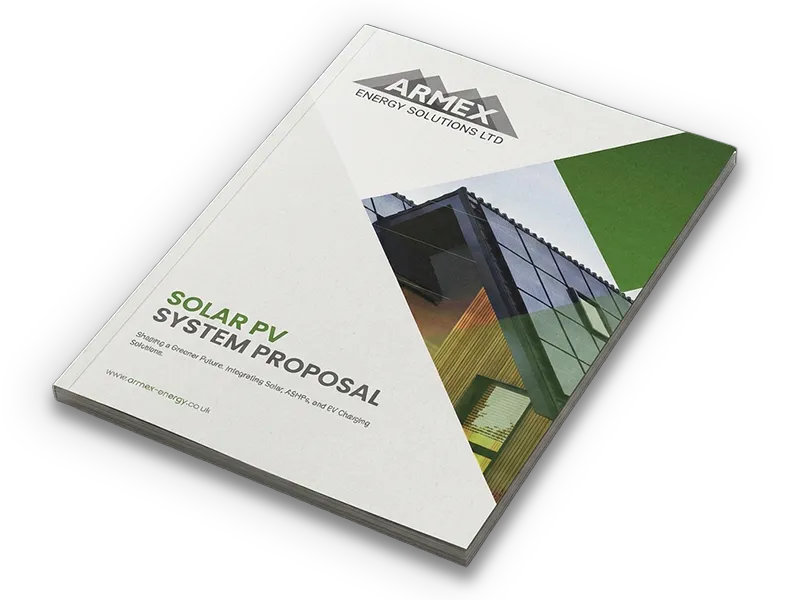
Get A Tailored Solar PV System Built Specifically For Your Site, Energy Usage, And Financial Goals
Make an enquiry today to see how much your business could save, with many systems effectively paying for themselves within 3 to 6 years.
With available tax incentives, you can significantly reduce upfront costs and benefit from long-term, low-cost energy.
Designed Using Real Data,
Not Estimates
We don’t guess, we model.
Using advanced software and real consumption data, we design a system that’s optimised for performance and return on investment.
Your location, roof orientation, and pitch are analysed to calculate potential solar generation.
Your half-hourly electricity data and operating hours are used to forecast realistic savings.
We design the optimal system size and configuration to maximise ROI.
Final performance figures are confirmed following a full technical site survey.
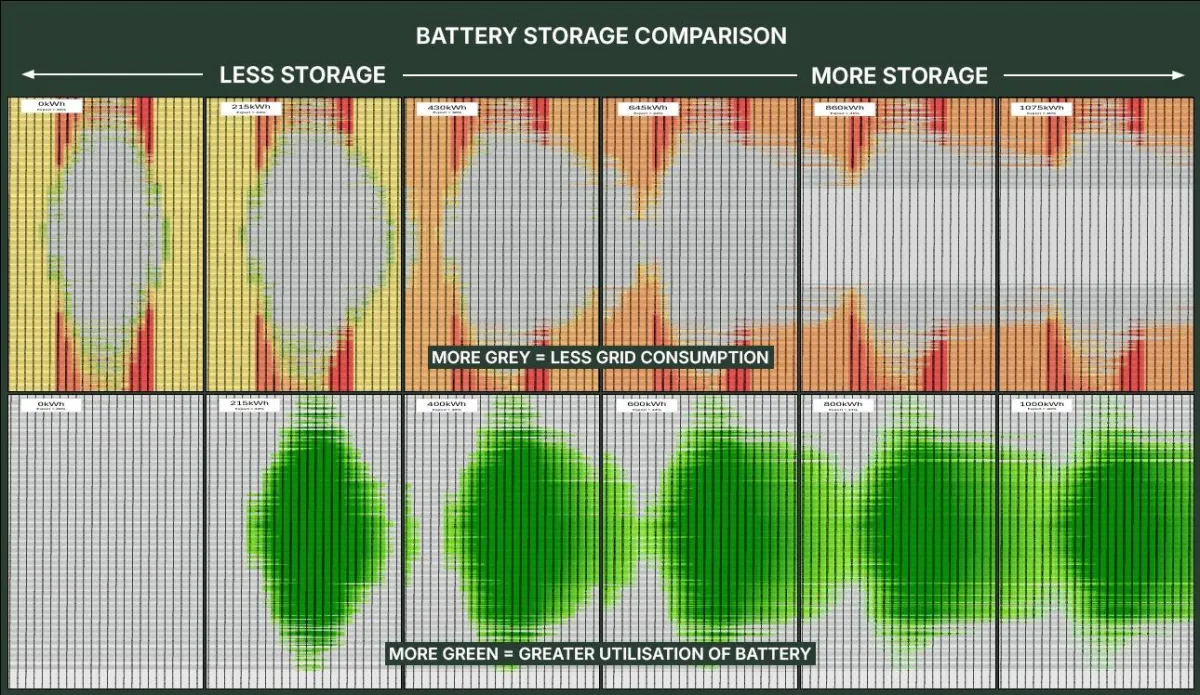
*This graph demonstrates how we model your energy usage to maximise battery usage and savings.
Clear Savings & ROI Forecasting
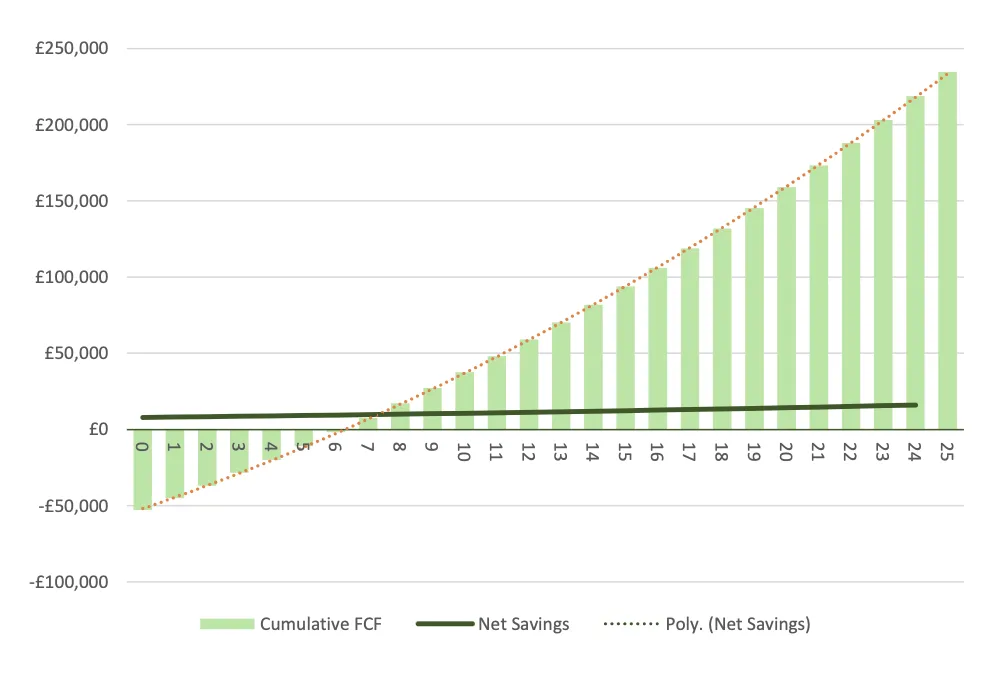
We provide a fully transparent financial breakdown so you can clearly understand the return on your investment before moving forward.
Using real consumption data and advanced modelling, we show exactly how your system is expected to perform financially and operationally over time.
We provide a detailed breakdown of:
Expected energy savings
Based on your actual usage profile, we calculate how much electricity your system will generate and how much you can offset from your current supplier costsPayback period
A clear projection of how long it will take for the system to pay for itself through energy savings and tax incentivesSystem performance over time
Long-term forecasts showing energy generation, degradation, and overall system efficiency across its lifespan
Return on investment (ROI)
A full financial model showing total savings, net profit over time, and overall return on your investment
Battery storage comparisons (if applicable)
We model different battery sizes to show how storage impacts savings, self-consumption, and ROI
With the support of the Annual Investment Allowance (AIA), many businesses can significantly reduce the upfront cost of their system by offsetting it against taxable profits.
This can accelerate payback to around 3 years or less, while improving overall return and making solar a highly cash-flow-positive investment from an early stage.
How Solar Works for Your Business
Solar panels convert daylight into usable electricity to power your business operations. By installing a tailored solar PV system, you can generate your own renewable energy, reduce reliance on your supplier, and lower your overall energy costs and carbon footprint.
Solar panels are made up of photovoltaic cells using semiconducting materials that produce electricity when exposed to light
The energy generated is in direct current (DC), which is then converted into alternating current (AC) by an inverter so it can be used across your site
The electricity produced is used on-site first, meaning every unit generated reduces the amount you need to purchase from your energy provider
Solar panels continue to generate electricity even on cloudy days, as they rely on daylight rather than direct sunlight
Higher light intensity leads to greater energy production, maximising output during brighter conditions
End-to-End Delivery from a Trusted Installer
We manage the entire process in-house, from design through to installation and ongoing support, ensuring everything runs smoothly and delivers the best possible outcome.
As an MCS-certified installer and trusted commercial partner, we deliver systems to the highest industry standards, giving you complete confidence in your investment.
Making Solar Financially Viable
We understand that investing in commercial solar is a significant upfront cost. However, the long-term savings from reducing your reliance on your energy supplier can quickly outweigh the initial investment. Whether your business operates from an office, warehouse, manufacturing facility, or distribution centre, many systems can effectively pay for themselves in around 3 years through energy savings alone.
Solar PV systems are also eligible for tax relief under the Annual Investment Allowance (AIA). This allows you to offset 100% of the system cost against your taxable profits, reducing your overall investment and improving your return. With government support, this can lower the effective cost of your system by around 19%.
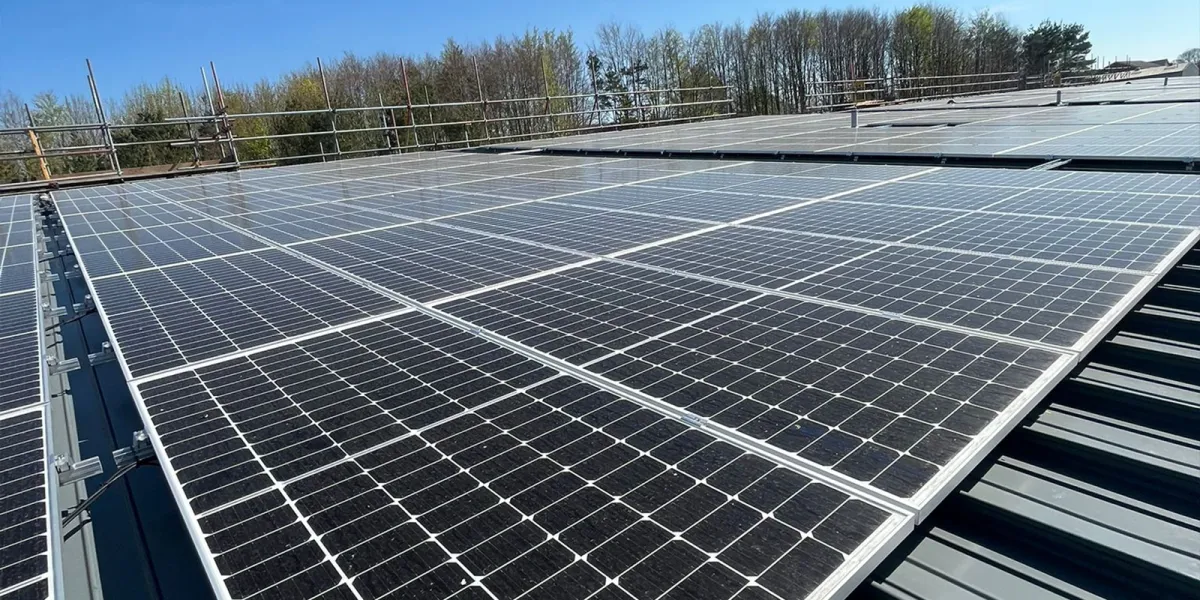
Once installed, your system will generate electricity directly from your rooftop, which can be used to power your business during operating hours. This reduces the amount of energy you need to purchase, helping you significantly cut costs while also lowering your carbon footprint.
For businesses with larger available roof space or land, there may also be opportunities to generate additional income by exporting excess energy or developing a larger-scale solar installation, subject to planning and grid approvals.
Some Of The Solar PV Brands We Install
We only work with Tier 1 manufacturers, independently recognised by BloombergNEF (BNEF) — one of the world’s leading research firms in renewable energy.
Who We Serve
Armex works with commercial and industrial businesses across a wide range of sectors.
We design and install bespoke solar PV systems tailored to each site’s energy usage and operational requirements.
Our goal is to help businesses reduce energy costs and improve long-term efficiency.
Automotive
Commercial Offices
Food Production
Industrial Facilities
Warehouses
Garden Centres
Our Commercial Solar PV Installations In Action
From assessment to installation
— we manage the entire process
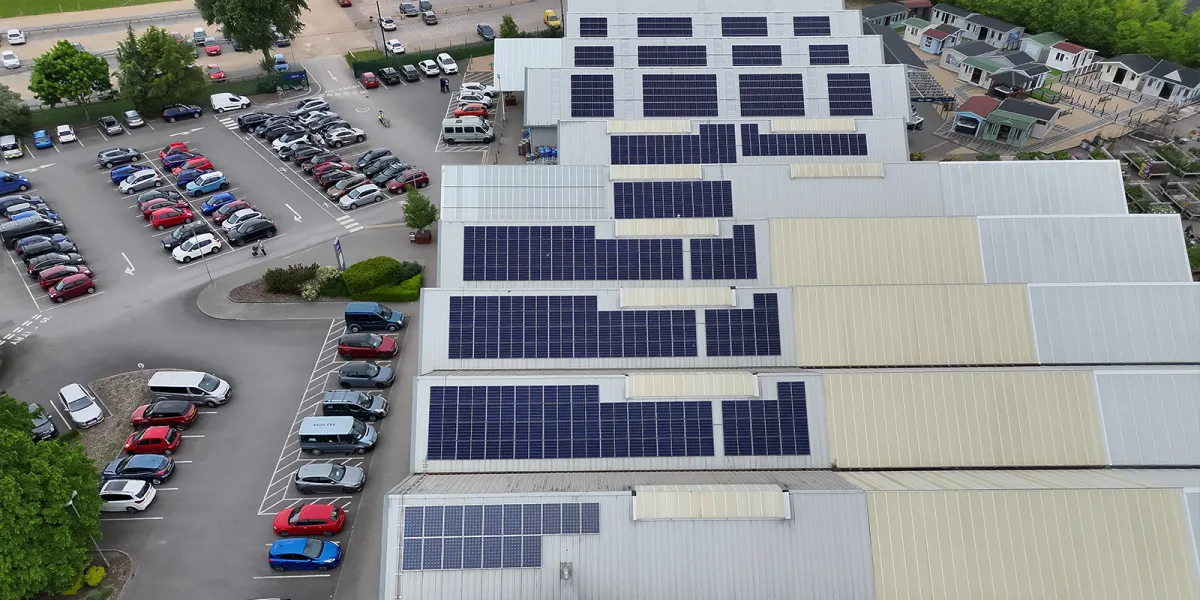
Multisite Retail
(738 kWp)
Stabilised energy costs across 7 high footfall garden center sites with a coordinated, minimal disruption rollout.
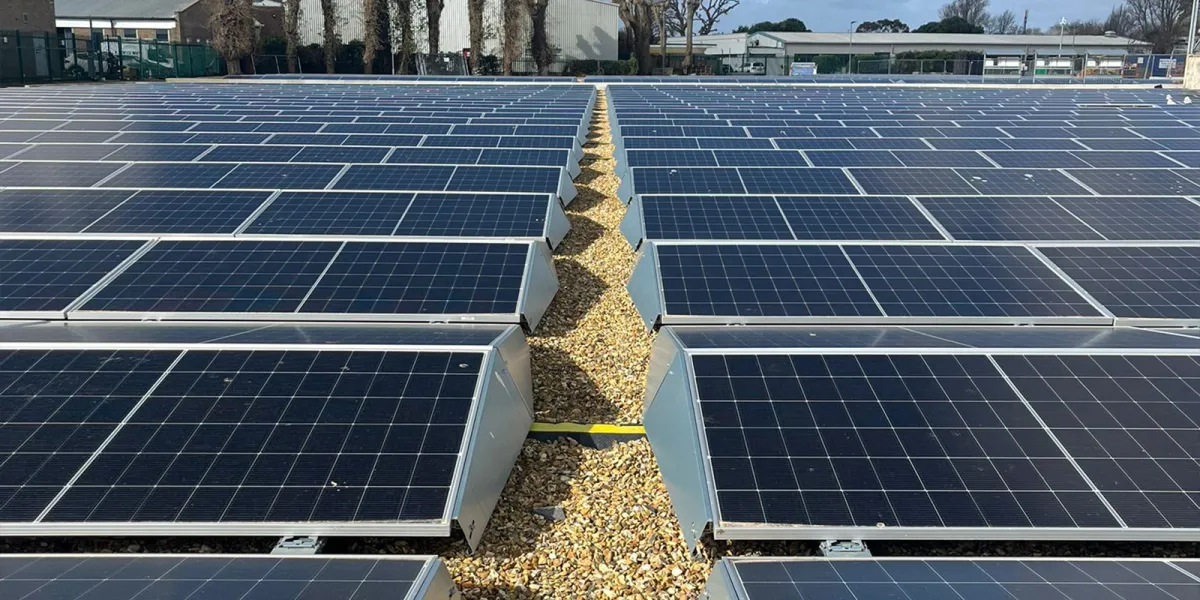
Pharmaceutical Manufacturing
(745 kWp)
Protected margins at an energy intensive site with fully monitored commercial solar PV systems, providing transparent ROI generation.
Get A Free Solar Assessment
Our team will assess your building and how solar impacts your EPC and compliance. You’ll receive a clear system outline with realistic ROI projections.
Tailored System Design
Performance Monitoring
Ongoing Maintenance
Expert Installation
3-6 Years Pay Back
PPA & Funding Options
Our Commercial
Solar Packages
We provide bespoke system designs for every business, based upon your energy usage and rooftop availability.
To give you an idea of the savings and cost of a system, the below are some of our common system sizes.
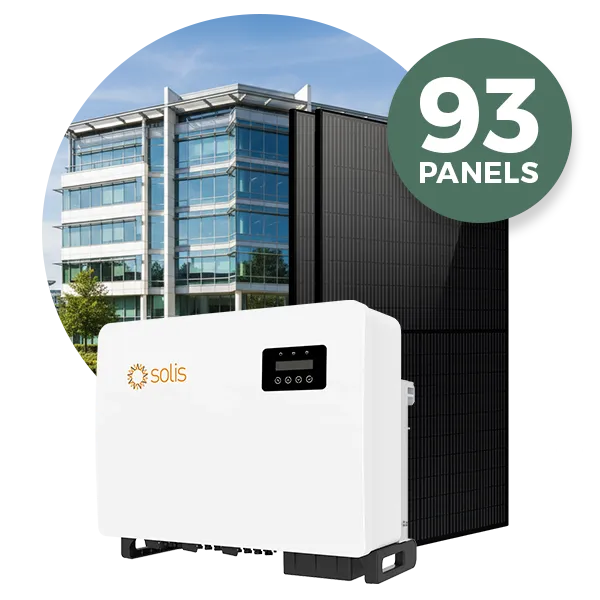
49.76kW
Solar PV System
Ideal for
Office Buildings
93 x 535W LONGi Solar Panels
1 x 50kW 3-Phase Solis String Inverter
25 Year Panel Product Warranty
30 Year Linear Power Output Warranty
MCS Certification
Extended Inverter Warranty
Save £7,213 per year
From £42,296
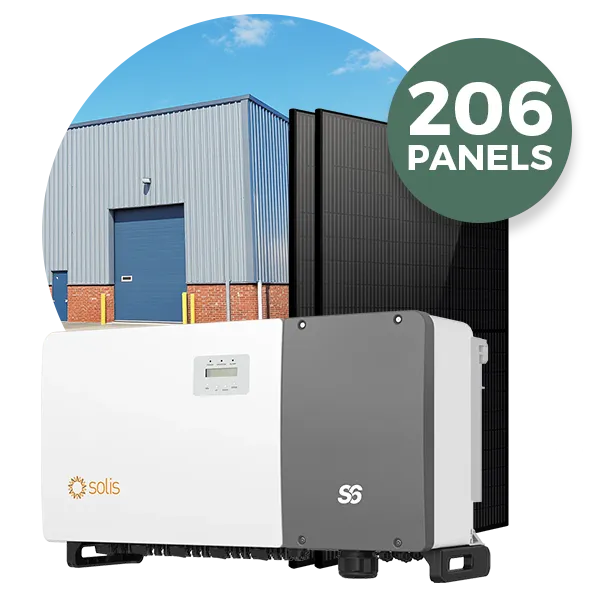
110.28kW
Solar PV System
Ideal for
Warehouse Buildings
206 x 535W LONGi Solar Panels
1 x 100kW 3-Phase Solis String Inverter
25 Year Panel Product Warranty
30 Year Linear Power Output Warranty
MCS Certification
Extended Inverter Warranty
Save £16,024 per year
From £89,879
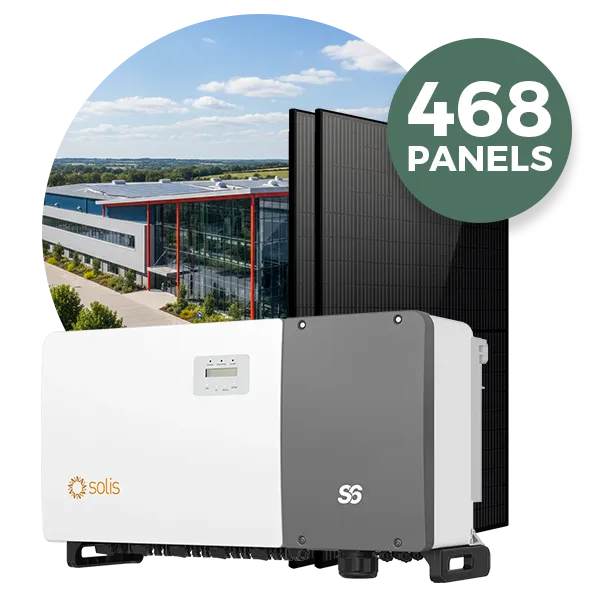
250.38kW
Solar PV System
Ideal for
Manufactiring Plants
468 x 535W LONGi Solar Panels
3 x 80kW 3-Phase Solis String Inverter
25 Year Panel Product Warranty
30 Year Linear Power Output Warranty
MCS Certification
Extended Inverter Warranty
Save £36,480 per year
From £194,045
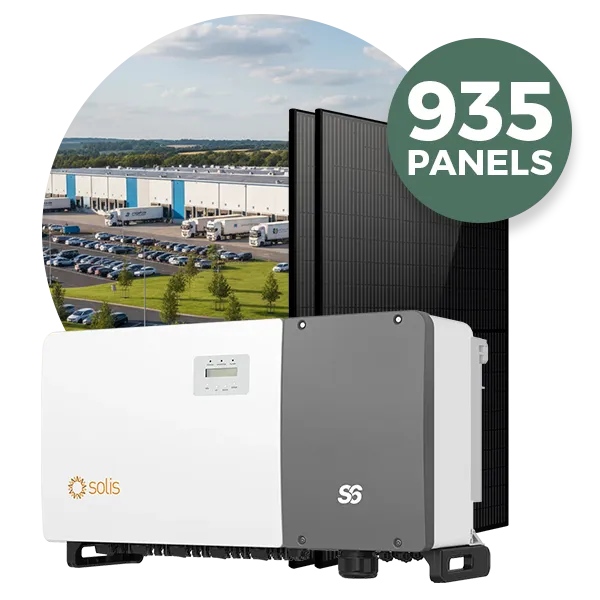
500.23kW
Solar PV System
Ideal for
Distribution Centres
935 x 535W LONGi Solar Panels
5 x 100kW 3-Phase Solis String Inverter
25 Year Panel Product Warranty
30 Year Linear Power Output Warranty
MCS Certification
Extended Inverter Warranty
Save £73,009 per year
From £375,169
Once you enquire, we will model a bespoke system based on your building and energy requirements to maximise energy savings, improve payback, and ensure the system is designed for the strongest financial return.
Why Go Solar With Your Business?
Installing solar allows your business to generate its own electricity, reduce operating costs, and protect against rising energy prices. With minimal maintenance, long-term warranties, and the potential to generate additional income from unused energy, solar is a reliable and future-proof investment.
Produce your own electricity to power daily operations
Reduce exposure to rising energy prices and market volatility
Earn from excess energy that your business doesn’t use
Benefit from low maintenance systems with a lifespan of 25 to 30 years or more
Take advantage of warranties of up to 25 years for added peace of mind
Increase the value and efficiency of your commercial property
Reduce upfront costs through available tax incentives and allowances
Position Your Business as an Eco-Conscious Brand
Beyond the financial benefits, switching to solar also demonstrates a clear commitment to sustainability and reducing your environmental impact.
By generating your own renewable energy, your business can actively lower its carbon footprint and contribute to a cleaner, more sustainable future.
Over the lifetime of your solar system, the environmental and financial impact can be significant:
Generate approximately 20,000 kWh of clean electricity
Save around £3,000 on energy costs
Reduce carbon emissions by roughly 9 tonnes of CO₂
Business Solar Panels FAQs
Are solar panels an option for every business premises?
In many cases, yes, and where there are challenges, there are often practical solutions.
Most commercial buildings can be assessed for solar, but the key factors are roof suitability, ownership, structural capacity, and shading. If your building is leased, installation may still be possible with the landlord’s approval.
If there are any concerns around the roof structure, we can arrange structural surveys and assessments to confirm suitability before any installation moves forward.
Where shading is a factor, this doesn’t always rule solar out. We can design around partial shading using optimised systems such as SolarEdge, helping to reduce the impact on performance and maximise generation.
The best way to find out is with a professional assessment, we’ll review your site and advise on the most suitable system for your building.
How eco-friendly are commercial solar panels?
Businesses have traditionally relied on fossil fuels like oil or gas or used electricity from the energy companies to generate heat. Solar panels are a greener choice because they are a low-carbon renewable source of energy generated from daylight. The electricity produced can meet your energy demands to power your business, and any excess can be stored in solar batteries, or even exported back to the Grid. As with all technologies, solar isn’t perfect and in the production and distribution of solar panels there are carbon impacts, however, these are typically offset within a short time of installation.
How much can solar panels save my business?
Savings vary depending on your system size, energy usage and site conditions, but most businesses see significant reductions in electricity costs from day one.
The biggest factor is how much energy you use during the day, as this is when your solar system is generating power. The more you use on-site, the more you can save. System design, roof orientation and shading can also influence performance, but these are all factored in during our assessment.
Typically, commercial systems are designed to deliver strong returns over 25+ years, with many businesses achieving payback in under 4–5 years, while continuing to generate free electricity long after.
We provide a tailored savings forecast for your site, so you can clearly see expected savings, return on investment, and long-term value before making a decision.
Do solar panels require planning permission?
Planning permission is not usually required for solar panels on commercial settings as they are normally considered ‘Permitted Development’. This is subject to the installation meeting the conditions laid down including size, height, distance from the property boundary, and visibility.
How long does a commercial solar installation take?
The time taken for a solar installation at a commercial premises will depend on the size and specific requirements of the project. Commercial installations can require multiple days to be installed, especially if the premises and roof space are large, and therefore requiring significant numbers of solar panels..
Is solar power still generated when it’s not bright outside?
Solar doesn’t require direct sunlight in order to generate, so electricity can still be produced on cloudier days, albeit at a lower rate. When your solar system is not producing electricity at sufficient rate to meet your business needs, you will just draw electricity from the grid, as you did prior to the solar installation.
How long are commercial solar panels expected to last?
Commercial solar panels will usually last between 20-25 years, but for more modern solar panels the lifespan could even reach 40 years. Efficiency can reduce over time and inverters need to be maintained and occasionally replaced, but overall the lifespan of solar panels is long, allowing you to get a return on your investment several times over.
What tax incentives are there for businesses?
Businesses can claim tax relief under the Annual Investment Allowance of up to £1 Million. This tax break allows you to take 100% of qualifying investments off of your taxable profits, thus reducing your corporation tax bill and in turn the cost of going solar. As an example, a solar PV system costing £166,600 could be reduced to £134,946 – being reduced by £31,654 (19% Corporation Tax). You may only claim a saving on solar against the Annual Investment Allowance if you have not exhausted the £1 Million annual cap. For more information read our full article on solar panel capital allowances.
Do I have to pay the entire cost of my solar setup at the beginning?
We know that a commercial solar PV system can be a significant outlay for some businesses and for this reason it is possible to pay the costs in instalments. We can refer you to asset finance providers to fund your system and pay for it over a period of 10 years.
What is the process and how quickly can I get solar installed?
Getting solar installed is a straightforward process, and we guide you through each step.
Once you get in touch, we’ll carry out an initial assessment and provide a bespoke system design and savings forecast for your site. We’ll then complete a site survey to finalise the technical design and confirm the best solution for your building.
For most commercial systems, we also need approval from your local electricity network operator (DNO). In simple terms, this is the company responsible for the local power network, and they need to confirm that your new solar system can be safely connected to the grid. This process typically takes 1–3 months.
Once this is in place, installation can usually be scheduled within around 4 weeks.
We manage the process from design through to installation and commissioning, making it as simple as possible for your business to start benefiting from solar.
How can I pay for Solar?
When it comes to commercial solar, there are a few ways to purchase your system, we’ll help to guide you through your options.

Annual Investment
Allowance (AIA)
Using the Annual Investment Allowance, you can deduct the cost of your system against corporation tax.
Asset Financing
Spread the cost with asset financing and use your bill savings to pay off your annual loan repayments
Power Purchase Agreement (PPA)
Using PPA funding, a third party installs, owns, and maintains the system while you pay only for the electricity it generates at an agreed rate, with no upfront cost.
Outright Purchase
Purchase your system outright, for the best return on investment
FULLY ACCREDITED SOLAR INSTALLERS



Start Your Solar Assessment Now
Our team will assess your building and how solar impacts your EPC and compliance. You’ll receive a clear system outline with realistic ROI projections.
How It Works
From assessment to installation — we manage the entire process
1. Speak To An Expert
Get in touch with the Armex team through our website or by phone. One of our commercial solar specialists will discuss your building, energy usage and business goals.
2. Site Assessment
Every project starts with an assessment of your site. We review your energy usage, operational profile, and any roof or land constraints.
3. Bespoke Proposal
At Armex, we don’t use templated proposals for commercial solar PV systems. Your system is designed around your building and how your business uses energy.
4. Cost & Savings Guidance
You’ll receive guidance on capital costs, payback periods, and long-term savings projections. We also assess the EPC impact before you commit.
5. Compliance & Installation
Our team handles EPC documentation, DNO applications, and any building regulations. Installation is scheduled around your operations to minimise disruption.
6. Monitoring & Maintenance
After handover, we provide remote monitoring with fault alerts. Long-term maintenance includes servicing and thermal imaging inspections.
7. Start Saving
Once installed, your system begins generating electricity for your business. This helps reduce energy bills and delivers long-term savings.
Does this apply to your business?
Keen to reduce your business electricity bills
Want to reduce reliance on the energy grid
Want to reduce your carbon footprint
Want to harness the power of the sun
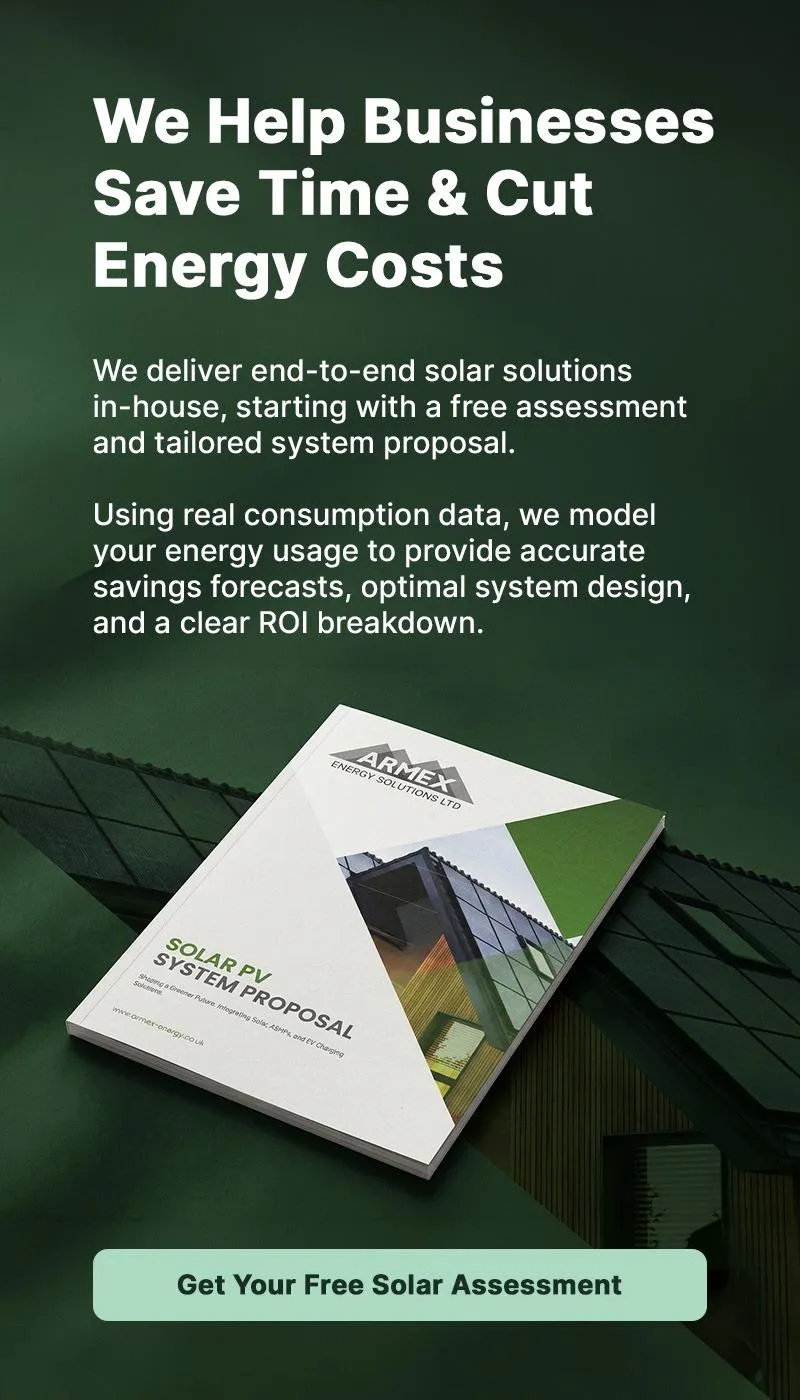
Get A Tailored Solar PV System Built Specifically For Your Site, Energy Usage, And Financial Goals
Make an enquiry today to see how much your business could save, with many systems effectively paying for themselves within 3 to 6 years. With available tax incentives, you can significantly reduce upfront costs and benefit from long-term, low-cost energy.
Designed Using Real Data, Not Estimates
We don’t guess, we model.
Using advanced software and real consumption data, we design a system that’s optimised for performance and return on investment.
Your location, roof orientation, and pitch are analysed to calculate potential solar generation.
Your half-hourly electricity data and operating hours are used to forecast realistic savings.
We design the optimal system size and configuration to maximise ROI.
Final performance figures are confirmed following a full technical site survey.
*This graph demonstrates how we model your energy usage to maximise battery usage and savings.
Clear Savings & ROI Forecasting
We provide a fully transparent financial breakdown so you can clearly understand the return on your investment before moving forward.
Using real consumption data and advanced modelling, we show exactly how your system is expected to perform financially and operationally over time.
We provide a detailed breakdown of:
Expected energy savings
Based on your actual usage profile, we calculate how much electricity your system will generate and how much you can offset from your current supplier costsPayback period
A clear projection of how long it will take for the system to pay for itself through energy savings and tax incentivesSystem performance over time
Long-term forecasts showing energy generation, degradation, and overall system efficiency across its lifespanReturn on investment (ROI)
A full financial model showing total savings, net profit over time, and overall return on your investmentBattery storage comparisons (if applicable)
We model different battery sizes to show how storage impacts savings, self-consumption, and ROI
With the support of the Annual Investment Allowance (AIA), many businesses can significantly reduce the upfront cost of their system by offsetting it against taxable profits.
This can accelerate payback to around 3 years or less, while improving overall return and making solar a highly cash-flow-positive investment from an early stage.
How Solar Works for Your Business
Solar panels convert daylight into usable electricity to power your business operations. By installing a tailored solar PV system, you can generate your own renewable energy, reduce reliance on your supplier, and lower your overall energy costs and carbon footprint.
Solar panels are made up of photovoltaic cells using semiconducting materials that produce electricity when exposed to light
The energy generated is in direct current (DC), which is then converted into alternating current (AC) by an inverter so it can be used across your site
The electricity produced is used on-site first, meaning every unit generated reduces the amount you need to purchase from your energy provider
Solar panels continue to generate electricity even on cloudy days, as they rely on daylight rather than direct sunlight
Higher light intensity leads to greater energy production, maximising output during brighter conditions
End-to-End Delivery from a Trusted Installer
We manage the entire process in-house, from design through to installation and ongoing support, ensuring everything runs smoothly and delivers the best possible outcome.
As an MCS-certified installer and trusted commercial partner, we deliver systems to the highest industry standards, giving you complete confidence in your investment.
Making Solar Financially Viable
We understand that investing in commercial solar is a significant upfront cost. However, the long-term savings from reducing your reliance on your energy supplier can quickly outweigh the initial investment. Whether your business operates from an office, warehouse, manufacturing facility, or distribution centre, many systems can effectively pay for themselves in around 3 years through energy savings alone.
Solar PV systems are also eligible for tax relief under the Annual Investment Allowance (AIA). This allows you to offset 100% of the system cost against your taxable profits, reducing your overall investment and improving your return. With government support, this can lower the effective cost of your system by around 19%.
Once installed, your system will generate electricity directly from your rooftop, which can be used to power your business during operating hours. This reduces the amount of energy you need to purchase, helping you significantly cut costs while also lowering your carbon footprint.
For businesses with larger available roof space or land, there may also be opportunities to generate additional income by exporting excess energy or developing a larger-scale solar installation, subject to planning and grid approvals.
Some Of The Solar PV Brands We Install
We only work with Tier 1 manufacturers, independently recognised by BloombergNEF (BNEF) — one of the world’s leading research firms in renewable energy.



Who We Serve
Armex works with commercial and industrial businesses across a wide range of sectors.
We design and install bespoke solar PV systems tailored to each site’s energy usage and operational requirements.
Our goal is to help businesses reduce energy costs and improve long-term efficiency.
Automotive
Commercial Offices
Food Production
Industrial Facilities
Warehouses
Garden Centres
Our Commercial Solar PV Installations In Action
From assessment to installation - we manage the entire process
Multisite Retail
(738 kWp)
Stabilised energy costs across 7 high footfall garden center sites with a coordinated, minimal disruption rollout.
Pharmaceutical Manufacturing
(745 kWp)
Protected margins at an energy intensive site with fully monitored commercial solar PV systems, providing transparent ROI generation.
Get A Free Solar Assessment
Our team will assess your building and how solar affects your EPC rating and compliance position. You’ll get a detailed system outline with realistic ROI projections, giving you a clear idea of what your next steps are.
Tailored System Design
Performance Monitoring
Ongoing Maintenance
Expert Installation
3-6 Years Pay Back
PPA & Funding Options
Our Commercial Solar Packages
We provide bespoke system designs for every business, based upon your energy usage and rooftop availability.
To give you an idea of the savings and cost of a system, the below are some of our common system sizes.
49.76kW
Solar PV System
Ideal for
Office Buildings
93 x 535W LONGi Solar Panels
1 x 50kW 3-Phase Solis String Inverter
25 Year Panel Product Warranty
30 Year Linear Power Output Warranty
MCS Certification
Extended Inverter Warranty
Save £7,213 per year
From £42,296
110.28kW
Solar PV System
Ideal for
Warehouse Buildings
206 x 535W LONGi Solar Panels
1 x 100kW 3-Phase Solis String Inverter
25 Year Panel Product Warranty
30 Year Linear Power Output Warranty
MCS Certification
Extended Inverter Warranty
Save £16,024 per year
From £89,879
250.38kW
Solar PV System
Ideal for
Manufactiring Plants
468 x 535W LONGi Solar Panels
3 x 80kW 3-Phase Solis String Inverter
25 Year Panel Product Warranty
30 Year Linear Power Output Warranty
MCS Certification
Extended Inverter Warranty
Save £36,480 per year
From £194,045
500.23kW
Solar PV System
Ideal for
Distribution Centres
935 x 535W LONGi Solar Panels
5 x 100kW 3-Phase Solis String Inverters
25 Year Panel Product Warranty
30 Year Linear Power Output Warranty
MCS Certification
Extended Inverter Warranty
Save £73,009 per year
From £375,169
Once you enquire, we will model a bespoke system based on your building and energy requirements to maximise energy savings, improve payback, and ensure the system is designed for the strongest financial return.
Why Go Solar With Your Business?
Installing solar allows your business to generate its own electricity, reduce operating costs, and protect against rising energy prices. With minimal maintenance, long-term warranties, and the potential to generate additional income from unused energy, solar is a reliable and future-proof investment.
Produce your own electricity to power daily operations
Reduce exposure to rising energy prices and market volatility
Earn from excess energy that your business doesn’t use
Benefit from low maintenance systems with a lifespan of 25 to 30 years or more
Take advantage of warranties of up to 25 years for added peace of mind
Increase the value and efficiency of your commercial property
Reduce upfront costs through available tax incentives and allowances
Position Your Business as an Eco-Conscious Brand
Beyond the financial benefits, switching to solar also demonstrates a clear commitment to sustainability and reducing your environmental impact.
By generating your own renewable energy, your business can actively lower its carbon footprint and contribute to a cleaner, more sustainable future.
Over the lifetime of your solar system, the environmental and financial impact can be significant:
Generate approximately 20,000 kWh of clean electricity
Save around £3,000 on energy costs
Reduce carbon emissions by roughly 9 tonnes of CO₂
Business Solar Panels FAQs
Are solar panels an option for every business premises?
In many cases, yes, and where there are challenges, there are often practical solutions.
Most commercial buildings can be assessed for solar, but the key factors are roof suitability, ownership, structural capacity, and shading. If your building is leased, installation may still be possible with the landlord’s approval.
If there are any concerns around the roof structure, we can arrange structural surveys and assessments to confirm suitability before any installation moves forward.
Where shading is a factor, this doesn’t always rule solar out. We can design around partial shading using optimised systems such as SolarEdge, helping to reduce the impact on performance and maximise generation.
The best way to find out is with a professional assessment, we’ll review your site and advise on the most suitable system for your building.
How eco-friendly are commercial solar panels?
Businesses have traditionally relied on fossil fuels like oil or gas or used electricity from the energy companies to generate heat. Solar panels are a greener choice because they are a low-carbon renewable source of energy generated from daylight. The electricity produced can meet your energy demands to power your business, and any excess can be stored in solar batteries, or even exported back to the Grid. As with all technologies, solar isn’t perfect and in the production and distribution of solar panels there are carbon impacts, however, these are typically offset within a short time of installation.
How much can solar panels save my business?
Savings vary depending on your system size, energy usage and site conditions, but most businesses see significant reductions in electricity costs from day one.
The biggest factor is how much energy you use during the day, as this is when your solar system is generating power. The more you use on-site, the more you can save. System design, roof orientation and shading can also influence performance, but these are all factored in during our assessment.
Typically, commercial systems are designed to deliver strong returns over 25+ years, with many businesses achieving payback in under 4–5 years, while continuing to generate free electricity long after.
We provide a tailored savings forecast for your site, so you can clearly see expected savings, return on investment, and long-term value before making a decision.
Do solar panels require planning permission?
Planning permission is not usually required for solar panels on commercial settings as they are normally considered ‘Permitted Development’. This is subject to the installation meeting the conditions laid down including size, height, distance from the property boundary, and visibility.
How long does a commercial solar installation take?
The time taken for a solar installation at a commercial premises will depend on the size and specific requirements of the project. Commercial installations can require multiple days to be installed, especially if the premises and roof space are large, and therefore requiring significant numbers of solar panels.
Is solar power still generated when it’s not bright outside?
Solar doesn’t require direct sunlight in order to generate, so electricity can still be produced on cloudier days, albeit at a lower rate. When your solar system is not producing electricity at sufficient rate to meet your business needs, you will just draw electricity from the grid, as you did prior to the solar installation.
How long are commercial solar panels expected to last?
Commercial solar panels will usually last between 20-25 years, but for more modern solar panels the lifespan could even reach 40 years. Efficiency can reduce over time and inverters need to be maintained and occasionally replaced, but overall the lifespan of solar panels is long, allowing you to get a return on your investment several times over.
What tax incentives are there for businesses?
Businesses can claim tax relief under the Annual Investment Allowance of up to £1 Million. This tax break allows you to take 100% of qualifying investments off of your taxable profits, thus reducing your corporation tax bill and in turn the cost of going solar. As an example, a solar PV system costing £166,600 could be reduced to £134,946 – being reduced by £31,654 (19% Corporation Tax). You may only claim a saving on solar against the Annual Investment Allowance if you have not exhausted the £1 Million annual cap. For more information read our full article on solar panel capital allowances.
Do I have to pay the entire cost of my solar setup at the beginning?
We know that a commercial solar PV system can be a significant outlay for some businesses and for this reason it is possible to pay the costs in instalments. We can refer you to asset finance providers to fund your system and pay for it over a period of 10 years.
What is the process and how quickly can I get solar installed?
Getting solar installed is a straightforward process, and we guide you through each step.
Once you get in touch, we’ll carry out an initial assessment and provide a bespoke system design and savings forecast for your site. We’ll then complete a site survey to finalise the technical design and confirm the best solution for your building.
For most commercial systems, we also need approval from your local electricity network operator (DNO). In simple terms, this is the company responsible for the local power network, and they need to confirm that your new solar system can be safely connected to the grid. This process typically takes 1–3 months.
Once this is in place, installation can usually be scheduled within around 4 weeks.
We manage the process from design through to installation and commissioning, making it as simple as possible for your business to start benefiting from solar.
How can I pay for Solar?
When it comes to commercial solar, there are a few ways to purchase your system, we’ll help to guide you through your options.
Annual Investment Allowance (AIA)
Using the Annual Investment Allowance, you can deduct the cost of your system against corporation tax.
Asset Financing
Spread the cost with asset financing and use your bill savings to pay off your annual loan repayments
Power Purchase Agreement (PPA)
Using PPA funding, a third party installs, owns, and maintains the system while you pay only for the electricity it generates at an agreed rate, with no upfront cost.
Outright Purchase
Purchase your system outright, for the best return on investment
Start Your Solar Assessment Now
Our team will assess your building and how solar impacts your EPC and compliance.
You’ll receive a clear system outline with realistic ROI projections.
BUSINESS ADDRESS
1 Pretoria Villas 44 Main Road,
Colden Common, Winchester,
England, SO21 1RR
CONTACT US
© Armex Energy 2026. All Rights Reserved
BUSINESS ADDRESS
1 Pretoria Villas 44 Main Road,
Colden Common, Winchester,
England, SO21 1RR
CONTACT US